Adjust contrast
Schriftgröße auswählen
Zum Bereich in Leichter Sprache Simple language

Product Search

Test, Diagnostic, and Service Equipment for Internal Combustion Engines

Compression Pressure Testers for Gasoline and Diesel Engines

The compression pressure test is an important mechanical diagnostic procedure for evaluating the pressure build-up in individual cylinders of an internal combustion engine. Abnormal or significantly divergent measurement values can indicate problems with valves, piston rings, the cylinder bore, or other components of the combustion chamber. However, the specific cause cannot always be clearly determined by the compression measurement alone.

Leitenberger Autotest Equipment offers professional compression pressure testers for gasoline and diesel engines in both analog and digital versions, as well as systems with Bluetooth transmission and documentation capabilities. A variety of measurement ranges and a comprehensive range of adapters enable their use on passenger car, commercial vehicle, industrial, and marine engines. If the compression test identifies problematic cylinders, a subsequent engine pressure leak test can help further narrow down the cause.

Frequently Asked Questions About Compression Testing

Compression readings must always be determined under defined test conditions and compared with the manufacturer’s specifications or with the other cylinders in the engine. In addition to the correct measurement range, the right adapter and a reproducible test procedure are particularly important. Here, we answer frequently asked questions about measuring compression pressure in gasoline and diesel engines.

  • What is a compression test?

    The compression pressure test measures the maximum pressure a cylinder builds up during the compression stroke.

    Depending on the engine design, the test device is connected to the combustion chamber via:

    • the spark plug hole,
    • the glow plug hole, or
    • the injector hole

    The engine is then run through its cycle according to the specified test procedure, and the compression pressure reached is measured.

  • Why is an engine's compression pressure tested?

    A compression test may be useful if you experience symptoms such as:

    • Starting problems
    • Loss of power
    • Rough engine idling
    • Misfires
    • Noticeable differences between cylinders
    • Increased oil consumption
    • Suspected mechanical engine wear.

    The test helps determine whether the individual cylinders are performing similarly and building sufficient pressure.

  • What can low compression pressure indicate?

    A noticeably low reading can have various causes.

    Possible areas include, for example:

    • Intake valve
    • Exhaust valve
    • Valve seat
    • Piston rings
    • Piston
    • Cylinder bore
    • Cylinder head gasket
    • Valve timing.

    The compression test initially indicates an abnormality. However, it does not automatically prove which of these components is the cause.

  • Can a compression test pinpoint exactly where the engine is leaking?

    No.

    A compression test can be used to determine whether a cylinder is experiencing abnormal pressure buildup.

    To then investigate more closely where pressure is escaping from the combustion chamber, an engine pressure leak test is recommended.

    Both diagnostic procedures therefore complement each other.

  • What is the difference between a compression pressure test and an engine pressure loss test?

    During the compression pressure test, the pressure generated by the engine itself during compression is measured.

    In contrast, during the engine pressure loss test, compressed air is introduced from the outside into the cylinder in question at a defined position.

    This allows not only the pressure loss to be assessed, but also to determine the area through which air escapes from the combustion chamber.

  • Which test should be performed first?

    When this type of fault occurs, the compression pressure of all cylinders is often compared first.

    If one cylinder stands out, a subsequent engine pressure loss test can help narrow down the cause more precisely.

    However, the specific test strategy depends on the vehicle, engine, fault symptoms, and manufacturer specifications.

  • Are all cylinders measured during a compression test?

    To ensure a meaningful evaluation, the cylinders should be tested under conditions that are as comparable as possible.

    Comparing the individual cylinders with one another, in particular, provides important information.

    A single measurement value without a comparison or manufacturer’s specification is often of limited value.

  • Do all cylinders have to have exactly the same compression pressure?

    No.

    There may be slight differences.

    What matters is which absolute values and which maximum permissible differences the engine manufacturer specifies.

    A blanket percentage limit for all gasoline and diesel engines would therefore not be appropriate.

  • Is there a standard compression ratio for all gasoline engines?

    No.

    There is no universal target value for all gasoline engines.

    The expected compression pressure depends, among other things, on:

    • Engine design
    • Compression ratio
    • Valve timing
    • Test conditions
    • Engine temperature
    • Starter speed.

    Therefore, the measured values must be compared with the specifications for the specific engine.

  • Is there a standard compression ratio for all diesel engines?

    There is no universal setpoint for diesel engines either.

    Due to their design, diesel engines often operate at higher compression pressures than gasoline engines. However, the actual setpoints and limit values vary considerably from one engine to another.

    For this reason, diesel engines also require a compression pressure tester with an appropriate measurement range that is specifically designed for them.

  • Why are there compression testers with measurement ranges of 25, 40, and 60 bar?

    Gasoline and diesel engines can have different compression pressure ranges.

    A measurement range suited to the engine allows for accurate readings while preventing the measuring device from being overloaded.

    Leitenberger therefore offers different measurement ranges for gasoline, diesel, and combined applications, depending on the specific use.

  • Is a wider measurement range always better?

    No.

    The measurement range should be appropriate for the intended application.

    A very wide measurement range is not necessarily optimal if the device is intended to measure only significantly lower pressures.

    At the same time, there must be sufficient margin to accommodate the maximum pressure that may actually occur.

  • What is KP 80?

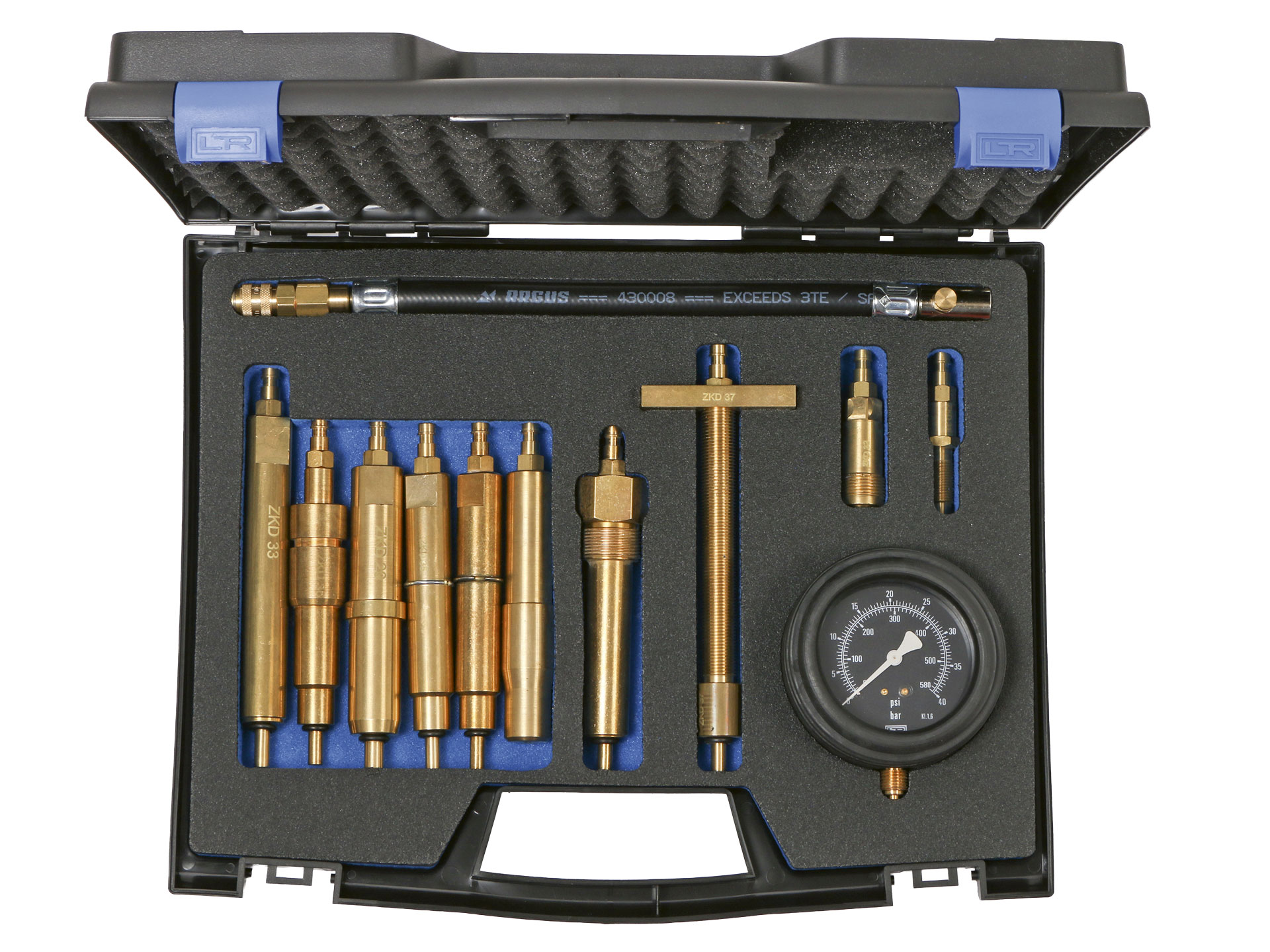
    The KP 80 is an analog compression pressure tester with a measurement range of 0 to 40 bar.

    The device features a precision analog pressure gauge and a flexible test hose with a quick-connect coupling, check valve, and pressure relief valve.

    When used with the appropriate adapters, it can be employed for various engine applications.

  • What is the advantage of a check valve in a compression tester?

    The check valve maintains the pressure built up in the measuring system during the individual compression cycles.

    This allows the maximum compression pressure to build up at the pressure gauge and then be read.

    After the measurement, the stored pressure can be released again via the pressure relief valve.

  • What is the pressure relief valve used for?

    The pressure relief valve allows the pressure stored in the tester to be released in a controlled manner after a measurement.

    This allows the device to be reset for the next measurement.

  • What is the advantage of a quick-connect coupling?

    A quick-connect coupling allows for quick switching between the test device and various adapters.

    This is particularly convenient when testing multiple cylinders or different engines.

    Leitenberger compression pressure systems use a DN5 quick-connect coupling for this purpose on numerous devices.

  • What is a digital compression testing machine?

    With a digital compression tester, the measured pressure is shown on an electronic display.

    Depending on the model, additional features such as:

    • Min/Max display
    • Peak value display
    • Various pressure units
    • Display backlight
    • Zero function

    are available.

  • What are the benefits of KPD 80.1?

    The KPD 80.1 features a precision digital pressure gauge with a measuring range of 0 to 60 bar.

    Depending on the application, the following features are available, among others:

    • large digital display
    • bar graph display
    • min/max peak values
    • reset and zero functions
    • display backlight
    • various pressure units

    This makes the device particularly suitable for workshops that want to read measurements directly in digital form.

  • What is the difference between an analog and a digital compression tester?

    An analog tester displays the pressure via a pointer-type pressure gauge.

    A digital device displays the measured value numerically and may offer additional functions depending on the model.

    Both types may be suitable for professional compression measurements.

    The choice depends primarily on:

    • the desired display
    • the required measurement range
    • additional functions
    • documentation requirements
  • Are there compression pressure testers with Bluetooth?

    Yes.

    The KP_BT01_LR compression pressure recorder transmits the measured values via Bluetooth to a smartphone or tablet.

    The measurement data can then be displayed, analyzed, and documented using the LR Smart Tools app.

  • What are the advantages of Bluetooth for compression testing?

    With Bluetooth-enabled measurements, readings can be displayed directly on a mobile device.

    Depending on the device, this allows for:

    • Live display
    • Graphical comparison
    • Storage
    • PDF documentation
    • Sharing of measurement results.

    Another advantage is the ability to perform a one-person test, in which the technician can operate the starter and simultaneously monitor the readings on the mobile device.

  • Are all Leitenberger compression testers Bluetooth-enabled?

    No.

    Bluetooth is an additional feature of certain devices, such as the KP_BT01_LR or the combined DRV 05_BT.

    Analog and other digital compression pressure testers operate without Bluetooth.

  • What is DRV 05_BT?

    DRV 05_BT combines two diagnostic procedures:

    • Compression pressure measurement
    • Engine pressure leak test.

    The measured values are recorded digitally and transmitted via Bluetooth to the LR Smart Tools app.

    This allows a follow-up engine pressure leak test to be performed and documented immediately after an abnormal compression measurement.

  • Is there a test kit that measures both compression and pressure loss?

    Yes.

    The DRV-KP-Kit 01 combines components for measuring compression pressure and testing engine pressure loss into a single test system.

    The basic configuration of the kit is designed specifically for gasoline engines and can be expanded with additional adapters for other applications.

  • Why are adapters so important in compression testing?

    The tester must connect the combustion chamber to the measuring device reliably and securely.

    Depending on the engine, access is provided via:

    • spark plug threads
    • glow plug threads
    • injector mount
    • other engine-specific openings.

    Therefore, the engine—or rather, the existing connection geometry—determines which adapter is required.

  • Is there a universal compression pressure adapter?

    There are adapters and adapter sets that are universally applicable or suitable for multiple engines.

    However, a single adapter does not automatically fit every engine.

    The thread, length, sealing surface, and installation space vary between vehicles and engines.

    Therefore, the adapter should always be selected based on the specific application.

  • Can the same adapter be used for compression testing and pressure loss testing?

    Yes, if the Leitenberger adapters are designed accordingly.

    Several adapters and adapter sets are available for both compression pressure testers and engine pressure loss testers.

    This reduces the need for duplicate engine-specific adapters.

  • Are there adapter sets for different motors?

    Yes.

    Leitenberger offers a variety of adapter sets and individual adapters for gasoline and diesel engines.

    These include, for example:

    • Spark plug adapters
    • Glow plug adapters
    • Injector adapters
    • Flexible adapters
    • Special adapters for passenger cars, commercial vehicles, and other applications.

    This allows the basic test unit to be adapted to different engines.

  • What is KP 80/5?

    KP 80/5 is a comprehensive compression pressure test kit for gasoline and diesel engines.

    The analog tester operates up to 40 bar and comes with a wide selection of adapters for various gasoline and diesel engines.

    This makes the kit particularly suitable for repair shops with a diverse fleet of vehicles.

  • Are there special compression testers for diesel engines?

    Yes.

    The KP 80/3A, for example, is specifically designed for diesel engines and has a measuring range up to 60 bar.

    This model can be used in a variety of applications, including trucks, ships, and industrial engines.

    The adapters required depend on the specific engine.

  • Are there compression pressure testers for trucks?

    Yes.

    The Leitenberger product line includes special versions and adapters for commercial vehicle diesel engines.

    For truck diesel engines, it is important to take into account both the higher pressure range and the adapter connections, some of which differ significantly.

  • Can industrial and stationary motors also be tested?

    Generally speaking, yes.

    Some devices and adapters are also designed for industrial or other high-displacement diesel engines.

    The key factors are:

    • Measurement range
    • Connection
    • Adapter
    • Permissible test conditions for the engine.
  • Are there special compression testers for marine engines?

    Yes.

    Leitenberger offers special analog and digital compression pressure gauges for marine engines.

    These differ significantly from standard automotive compression testers in terms of design and measurement ranges.

    For marine applications, the tester specifically designed for this purpose should therefore be used.

  • Can a standard 40- or 60-bar passenger car compression tester be used for any marine engine?

    No.

    Large marine diesel engines may require different measurement ranges, connections, and test procedures.

    Leitenberger offers its own compression pressure testers for marine engines for this purpose.

    The tester must therefore always be selected to match the specific engine.

  • Does the engine need to be warm for a compression test?

    Test conditions are based on the specifications provided by the respective engine manufacturer.

    A specific engine or operating temperature is often required because temperature, lubrication, and component clearance can affect the measured compression pressure.

    It is crucial that all cylinders be tested under conditions that are as comparable as possible and in accordance with the specified requirements.

  • Does the starter speed affect the compression pressure?

    Yes.

    The speed at which the engine is revved during the measurement can affect the measurement result.

    A weak battery, a faulty starter, or other causes of a significantly altered starter speed can therefore compromise the comparability of the measured values.

  • Why does the battery need to be sufficiently charged during a compression test?

    Adequate battery power helps maintain as steady a starter speed as possible during the test.

    If the starter speed drops significantly during the measurement, the compression readings may also change.

    Test conditions should therefore remain as constant as possible during the measurement.

  • Does the fuel supply need to be shut off during the compression test?

    The engine must not start unintentionally during a standard compression test.

    Depending on the engine design, the fuel supply and, if applicable, the ignition must therefore be deactivated in accordance with the manufacturer’s specified procedure.

    The exact procedure depends on the vehicle and the engine management system.

  • Do all spark plugs have to be removed from a gasoline engine?

    That depends on the specified test procedure.

    To ensure reproducible measurement conditions, it may be necessary to remove the spark plugs or corresponding components from all cylinders.

    The specifications for the respective engine and the test procedure used are decisive.

  • Does the throttle valve have to be open during the compression test?

    In gasoline engines, the position of the throttle valve or the air intake path can affect the measurement results.

    Therefore, the engine must be prepared in accordance with the specified test procedure.

    For modern electronic throttle valves, no general manual adjustments should be made; instead, the manufacturer’s specifications should be followed.

  • How many compaction strokes are required for a measurement?

    There is no single number that applies to every engine.

    The test equipment must be operated until a stable or maximum reading has been established in accordance with the specified test procedure.

    It is also crucial to test all cylinders under the same conditions.

  • Why does the testing device need to be securely connected?

    A leak between the combustion chamber and the test device can cause pressure to escape, resulting in a reading that is too low.

    Therefore, the following must be:

    • Adapters
    • Sealing surfaces
    • Hose connections
    • Quick-connect couplings

    properly installed and leak-free.

  • Can the wrong adapter skew the measurement results?

    Yes.

    An adapter that does not fit properly or is leaking can cause a loss of pressure in the test setup.

    In addition, the length and design of the adapter must match the motor to prevent damage to any components.

  • What does it mean if one cylinder has significantly less compression than the others?

    One obvious difference is that the cylinder in question builds up less pressure under the given test conditions.

    Possible causes may include, among others:

    • Valves
    • Piston rings
    • Cylinder
    • Cylinder head gasket
    • Valve timing

    A subsequent engine pressure loss test can help narrow down the cause further.

  • What does it mean if all cylinders have values that are too low?

    If all cylinders show similarly low readings, both mechanical causes and unsuitable test conditions should be considered.

    For example, the following should be checked:

    • correct setpoint
    • starter speed
    • battery
    • engine or test temperature
    • air supply
    • measuring device
    • adapter and test setup
    • valve control or timing.

    Therefore, the diagnosis should not be based solely on a single absolute numerical value.

  • Can a faulty cylinder head gasket be detected with a compression test?

    A damaged cylinder head gasket can result in abnormal compression readings.

    However, a compression test alone does not conclusively prove that the cylinder head gasket is the cause.

    Depending on the symptoms, the following additional tests may be useful:

    • Engine pressure loss test
    • CO₂ leak test for the cylinder head and cylinder head gasket
    • Cooling system pressure test
    • Other engine-specific diagnostics.
  • When is an additional CO₂ leak test recommended?

    If there is a suspicion that combustion gases are entering the cooling system, a CO₂ leak tester for the cylinder head and cylinder head gasket can be a useful addition.

    Compression testing and CO₂ testing examine different aspects of a potential engine problem and are therefore not interchangeable.

  • Can a compression test definitively confirm piston ring wear?

    No.

    Worn or leaky piston rings can contribute to low compression.

    However, a compression test alone cannot definitively distinguish between piston rings, valves, and other possible sources of leakage.

    For further evaluation, an engine pressure leak test and, if necessary, crankcase pressure and blow-by measurements may be useful.

  • What role does blow-by measurement play at low compression?

    An increased blow-by volume can provide additional evidence of gas leakage between the piston, piston rings, and cylinder wall.

    However, it addresses a different diagnostic issue than the compression test.

    For a more comprehensive mechanical evaluation of the engine, compression pressure testers, engine pressure loss testers, and crankcase pressure and blow-by meters can therefore be used in combination.

  • Can electronic vehicle diagnostics replace the compression pressure test?

    Not entirely.

    Electronic diagnostic systems can, for example:

    • Detect misfires
    • Compare cylinder contributions
    • Display error codes
    • Evaluate sensor data.

    The compression pressure test, on the other hand, directly measures the mechanically generated pressure in the combustion chamber.

    For certain fault patterns, both methods complement each other.

  • Which compression pressure tester is suitable for a multi-brand repair shop?

    The following points are particularly important for a multi-brand repair shop:

    • Suitable measurement range for gasoline and/or diesel engines
    • Extensive range of adapters
    • Quick-change adapters
    • Expandability for additional engines
    • Choice of analog or digital display
    • Documentation function, if needed.

    A comprehensive test kit such as the KP 80/5 or a digital or Bluetooth-enabled system may therefore be a sensible choice, depending on the workshop’s profile.

  • What equipment is recommended for a comprehensive compression diagnosis?

    Depending on your fleet of vehicles, professional equipment may include:

    • an analog or digital compression pressure tester
    • appropriate adapters for spark plug, glow plug, and injector ports
    • additional adapter sets for various engines
    • Engine pressure loss tester
    • Top dead center (TDC) setting tool
    • Bluetooth system for documentation, if applicable
    • Crankcase pressure and blow-by meters for further diagnostics.

    You can find additional testing and diagnostic equipment under Testing, Diagnostic, and Service Equipment for Internal Combustion Engines.

Cookie settings
This website uses cookies that enable you to use services offered by external providers, such as YouTube or Google Maps. The legal basis here is Art. 6 DSGVO (1) a.

Here you can object to the anonymized recording of your user behavior by MATOMO. For this purpose, we store a cookie on your computer to respect this decision also on subsequent visits.

Please note that depending on your settings, some functions may not be available.

You can find more information in our Privacy policy

Matomo settings

Attention: When you object to tracking, a Matomo deactivation cookie is set that remembers your objection.