Adjust contrast
Schriftgröße auswählen
Zum Bereich in Leichter Sprache Simple language

Product Search

Testing and Diagnostic Technology for E-Mobility and Alternative Powertrains

Thermal management Electric vehicles filling and testing equipment

The filling and testing of cooling circuits / thermal management systems of HV battery systems is basically the same procedure as for combustion engines. What is new is that the cooling circuits in HV battery systems are also relevant to safety. A lack of cooling capacity, e.g. due to air bubbles and / or leaks that lead into the interior of the HV battery, can result not only in property damage but also in personal injury. Correct filling and checking of the HV cooling circuit is therefore essential.

Solutions from Autotestgeräte Leitenberger support you:

  • when filling the cooling circuits in order to generate the best possible filling level and thus the best possible cooling performance
  • when checking the HV cooling circuit
  • when generating pressure and vacuum for testing purposes
  • when locating a possible leak

This allows you to work very safely and comfortably on the cooling system, generate a test pressure and verify or exclude any pressure drop in the HV cooling system.

Frequently Asked Questions About Thermal Management in Electric Vehicles

Thermal management in modern electric and hybrid vehicles involves much more than simply filling a cooling system. Leak-tightness, complete bleeding, coolant quality, and proper electrical conductivity can be critical to the system’s reliable operation. The following questions explain the most important testing and service procedures.

  • What is thermal management in an electric car?

    Thermal management refers to the targeted regulation of temperatures in various vehicle components.

    Depending on the vehicle, the following components, for example, can be temperature-controlled:

    • High-voltage battery
    • Power electronics
    • Inverter
    • Electric motor
    • On-board charger
    • Vehicle interior
    • Other electrical components

    Depending on the operating conditions, the system can absorb, dissipate, or distribute heat, or use it for other areas of the vehicle.

  • Why is thermal management important for a high-voltage battery?

    High-voltage batteries operate within defined temperature ranges.

    Thermal management helps cool or heat the battery depending on operating and environmental conditions.

    The exact temperature strategy is determined by the vehicle or battery manufacturer.

  • What components can be part of the thermal management system?

    Depending on the vehicle architecture, these may include the following components, for example:

    • Coolant pumps
    • Valves
    • Cooling plates
    • Heat exchangers
    • Radiators
    • Chillers
    • Expansion tanks
    • Electric heating elements
    • Air conditioning system or refrigerant circuit
    • Sensors and control units

    Modern electric vehicles can combine multiple cooling and temperature circuits.

  • Is the cooling system in an electric car the same as that in a car with an internal combustion engine?

    No.

    Although both systems use some of the same basic principles of liquid cooling, modern electric vehicles can have significantly more complex thermal management architectures.

    In addition to cooling or temperature control of the battery, power electronics, the electric motor, the on-board charger, and the passenger compartment, for example, can be integrated into separate or interconnected circuits.

  • Why should a cooling system be properly bled after a repair?

    Air bubbles can impair coolant circulation and, consequently, heat transfer.

    Under unfavorable conditions, air pockets can also prevent certain areas of the cooling system from receiving an adequate supply of coolant.

    After performing work on the cooling system, it is therefore necessary to ensure, in accordance with the vehicle manufacturer’s specifications, that the system is properly filled and bled.

  • Why is air in the cooling system a problem?

    Air has different thermal properties than the intended liquid coolant and is also compressible.

    Larger volumes of air can therefore, among other things:

    • impair the coolant flow,
    • deteriorate local heat transfer,
    • affect pump operation,
    • and make it difficult to ensure consistent performance of the thermal management system.

    Therefore, the specified filling and bleeding procedure should be followed.

  • What is vacuum filling of the cooling system?

    During vacuum filling, air is first removed from the closed cooling system.

    This creates a negative pressure, or vacuum.

    The prepared coolant is then drawn in through a filling hose. The resulting pressure difference helps transport the coolant into the previously evacuated areas of the cooling system.

  • What are the advantages of vacuum filling?

    A vacuum filling process performed properly can:

    • remove air from the system,
    • reduce the risk of large air pockets,
    • enable rapid filling,
    • and allow for an initial check of the system’s tightness before filling.

    The Leitenberger KVB 01, for example, combines vacuum generation, leak testing, and subsequent filling.

  • How does a radiator vacuum filling device work?

    The KVB 01 uses a Venturi tube and shop compressed air to create a vacuum in the cooling system.

    If the vacuum remains stable during the intended test, the prepared coolant is drawn into the cooling system through a suction hose.

    This allows the system to be filled quickly and with minimal air bubbles.

  • Can a vacuum fill test be used to check for leaks at the same time?

    A vacuum hold test can provide an indication of the cooling system’s leak-tightness.

    If the vacuum generated is not sufficiently stable, the system should not simply be refilled; instead, the cause should be investigated in accordance with the test specifications.

    For specialized pressure and leak tests, suitable cooling system test equipment can also be used.

  • Is a vacuum test the same as a pressure test?

    No.

    During a vacuum test, a negative pressure is created in the cooling system.

    In contrast, during a pressure test, the system is subjected to a defined positive pressure.

    Which method is used and which limit values apply depend on the vehicle, the cooling circuit, and the manufacturer’s specifications.

  • How is the cooling circuit of a high-voltage battery tested for leaks?

    Depending on the vehicle, the cooling system can be tested at a specified pressure or vacuum.

    For example, the LR 150_LR_EV_1 is a special cooling system test kit designed for high-voltage batteries.

    The measurement range is 0 to 4 bar absolute pressure with a resolution of 1 mbar.

    The actual permissible test pressure must always be taken from the respective vehicle manufacturer’s specifications.

  • What is the difference between a leak test on the cooling system and one on the battery case?

    These are two different test procedures.

    The cooling circuit test verifies whether the lines, cooling plates, connections, and other components of the thermal management system are sufficiently leak-tight.

    The battery housing test, on the other hand, evaluates the external leak-tightness of the battery housing against environmental influences.

    You can find suitable devices for the housing test under Leak testers for HV batteries and high-voltage components.

  • What is residual air in a cooling system?

    Residual air refers to the air that remains in the cooling system after a filling or venting process.

    The permissible amount of residual air depends on the specific system and the manufacturer’s requirements.

    A low residual air volume can be an important criterion for the quality of the filling, particularly in demanding development, production, or quality control processes.

  • How can the amount of residual air in the cooling system be measured?

    The RLM 01_LR takes advantage of the different compressibility properties of air and liquid.

    The device dispenses coolant in small volume increments into the fully filled system and simultaneously measures the resulting change in pressure.

    The volume change and pressure increase can be used to determine the amount of residual air remaining in the system.

  • How quickly does the RLM 01_LR measure residual air?

    The automatic measurement process is completed in approximately two minutes.

    The cooling system or thermal management system must be cooled down in accordance with the device requirements before the measurement.

  • How much residual air can the RLM 01_LR measure?

    The RLM 01_LR is designed for residual air volumes up to a maximum of 1,400 ml.

    Leitenberger specifies the measurement error as a maximum of ±3% relative to the actual residual air volume.

    The measurement results can then be documented.

  • Why is a documented residual air measurement important?

    Objective residual air measurement makes it possible to compare different filling processes.

    This is useful, for example, for:

    • Development
    • Test benches
    • Production
    • Rework
    • Process optimization
    • Quality assurance

    The RLM 01_LR can document measurement values in PDF format.

  • What is the function of the coolant in an electric vehicle?

    Depending on the cooling system, the coolant performs several functions.

    These may include:

    • Absorbing and dissipating heat
    • Maintaining the temperature of components
    • Frost protection
    • Overheating protection
    • Corrosion protection
    • Protection against deposits

    In certain high-voltage applications, there are additional requirements regarding electrical conductivity.

  • Can standard coolants be used in any electric car?

    No.

    The coolant specified for a vehicle is determined by the manufacturer's approval.

    Electric vehicles may use different coolant technologies depending on their cooling system.

    Therefore, a coolant should not be selected based solely on its color or a general description.

  • What does LECC stand for?

    LECC stands for Low Electrical Conductivity Coolant.

    This term refers to coolants that have been developed to provide low or controlled electrical conductivity.

    Such coolants are used in certain electric and hybrid vehicle cooling systems.

    For more information, see LECC/LCC – Testing Low-Conductivity Coolants.

  • Is LECC the same thing as a dielectric cooling fluid?

    No.

    An LECC is a low-conductivity coolant designed for appropriately configured indirect cooling circuits.

    In a conventional indirect battery cooling system, the coolant flows through cooling plates or channels and is not in constant direct contact with the energized battery cells.

    In contrast, true direct or immersion cooling requires dielectric thermal fluids specifically designed for this purpose.

    For more information, see Immersion and Direct Cooling of HV Batteries.

  • Do LECC coolants need to be diluted with water before use?

    It depends on the product.

    Depending on the product, coolants are available as concentrates or as ready-to-use mixtures.

    Specialty coolants with low thermal conductivity, in particular, may be supplied as ready-to-use products.

    Therefore, you should only dilute the coolant yourself if this is expressly recommended by the coolant or vehicle manufacturer.

  • Why can't a low-conductivity coolant simply be mixed with regular coolant?

    Mixing can alter the chemical and electrical properties of the coolant.

    In a system designed for low electrical conductivity, for example, this can cause the conductivity to increase significantly.

    Therefore, the vehicle and coolant manufacturer’s specifications regarding coolant type, top-off fluid, and miscibility must be followed.

  • Why is the electrical conductivity of an EV coolant measured?

    Electrical conductivity describes how well a liquid can conduct an electric current.

    In certain high-voltage and fuel cell systems, low or precisely defined conductivity is an important property of the coolant used.

    Conductivity can change due to aging, contamination, mixing, or the use of unsuitable make-up water.

  • In what unit is the electrical conductivity of coolant measured?

    Electrical conductivity is often expressed in microsiemens per centimeter (µS/cm) or, for higher conductivity values, in millisiemens per centimeter (mS/cm).

    The specific limit values for a particular coolant must be found in the respective manufacturer's specifications.

  • Is there a general maximum conductivity value for electric car coolant?

    No.

    There is no universal threshold that applies to all electric vehicles and coolants.

    Different cooling systems and coolants may have different specifications.

    The measured value must therefore always be compared with the specifications provided by the vehicle or coolant manufacturer.

  • What conductivity meters does Leitenberger offer?

    Leitenberger offers the following products, among others, for determining the conductivity of coolants:

    • LWM 01_LR
    • LWM 02_LR

    The LWM 02_LR is a portable handheld conductivity meter with multiple measurement ranges, temperature compensation, and a data logger.

    It is suitable, among other things, for determining the conductivity of coolants in high-voltage and fuel cell vehicles.

  • What is the measurement range of the LWM 02_LR?

    The LWM 02_LR has several measurement ranges:

    • 0–200 µS/cm
    • 0–2,000 µS/cm
    • 0–20 mS/cm
    • 0–500 mS/cm

    Alternatively, the device can select the measurement range automatically.

    The temperature is also recorded and compensated for during the measurement.

  • Can the conductivity measurement be documented?

    Yes.

    The LWM 02_LR features a data logger capable of storing up to 4,000 data points, as well as a USB interface for configuration and data logging.

    This makes it suitable for applications where measured values need to be documented or analyzed at a later time.

  • Why is temperature important when measuring conductivity?

    The electrical conductivity of a liquid depends on temperature.

    Therefore, temperature must be taken into account for an accurate measurement.

    The LWM 02_LR features temperature measurement and compensation for a range from 0 to 100 °C.

  • Why is the pH level of a coolant tested?

    The pH value is an important chemical parameter for assessing the condition of a coolant.

    Changes in the pH value can, among other things, indicate aging or changes in the coolant's chemical properties.

    However, the acceptable pH range depends on the specific coolant and manufacturer.

  • Is there a general optimal pH level for all electric car coolants?

    No.

    A universal target value for all coolants would not be technically correct.

    The measured pH value must be compared with the specifications for the coolant being used or the vehicle manufacturer’s guidelines.

  • Which device is suitable for measuring the pH of coolant?

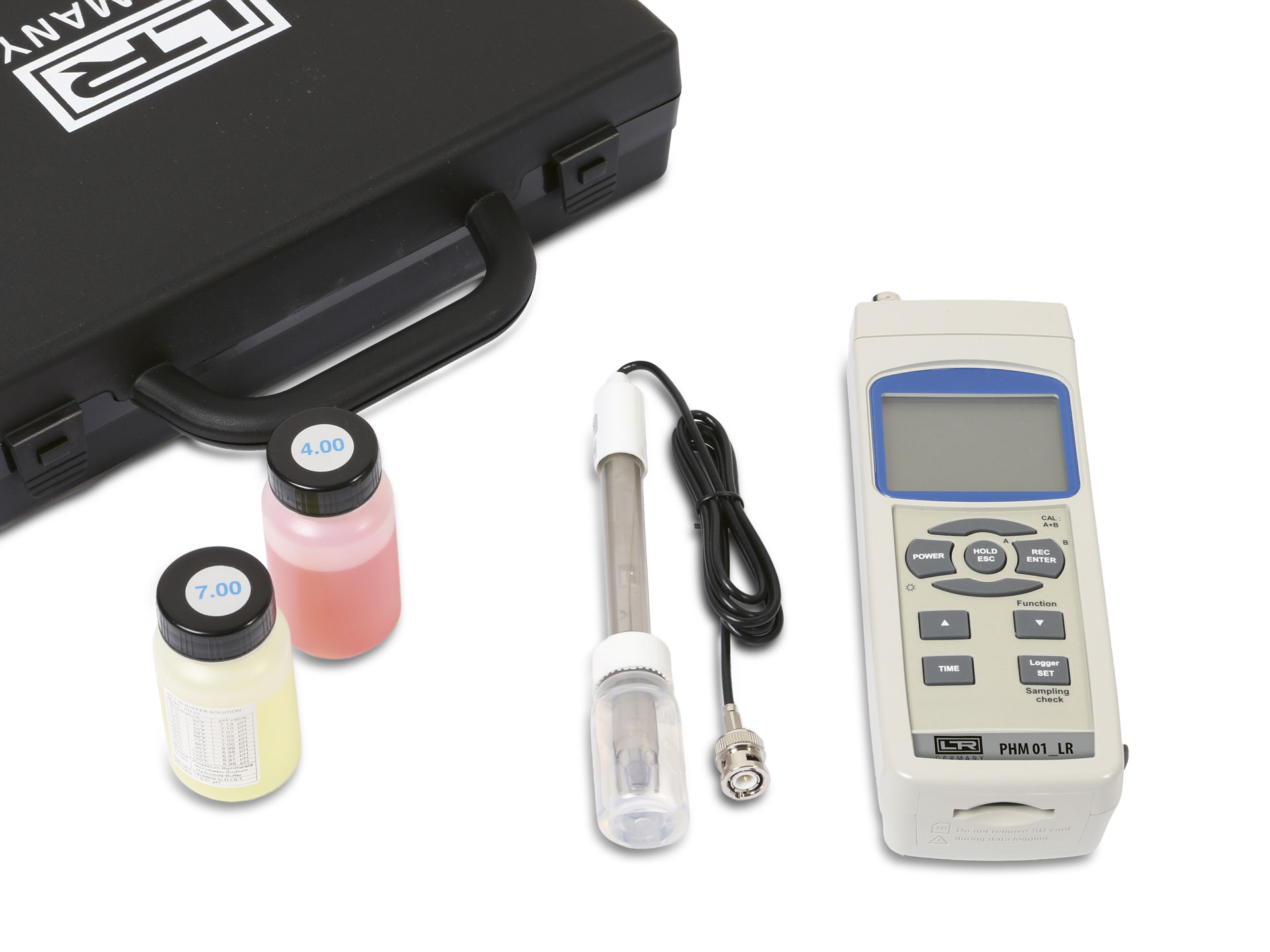
    The PHM 01_LR is a professional pH meter for coolant in electric, hybrid, fuel cell, and internal combustion engine vehicles.

    It has a measurement range of pH 0.00 to 14.00 and a resolution of 0.01 pH.

    The device also features automatic or manual temperature compensation.

  • Is a pH measurement the same as a conductivity measurement?

    No.

    These two measurements assess different properties of a liquid.

    pH:
    provides information about the acidity or alkalinity of the liquid.

    Electrical conductivity:
    describes the liquid’s ability to conduct electricity.

    For certain coolants, therefore, both parameters may be relevant.

  • Can a refractometer measure the electrical conductivity of a coolant?

    No.

    A refractometer and a conductivity meter operate on different measurement principles.

    For example, a suitable refractometer can be used to assess antifreeze levels or the concentrations of certain glycol-based coolants.

    For electrical conductivity, on the other hand, a suitable conductivity meter is required.

  • Is a freeze protection test sufficient to fully evaluate an EV coolant?

    No.

    An antifreeze or concentration test evaluates only a specific aspect of the coolant.

    Depending on the coolant used, additional parameters such as:

    • electrical conductivity
    • pH
    • chemical condition
    • contaminants
    • corrosion protection

    may also be important.

  • What is a coolant analysis?

    A coolant analysis examines the condition and various properties of a collected coolant sample.

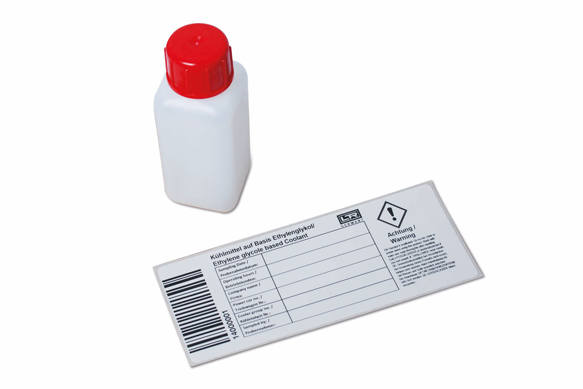
    Leitenberger offers various analysis packages for this purpose, as well as the PEK 01 sample collection kit.

    A more in-depth analysis may be particularly useful when a simple on-site measurement of individual parameters is insufficient.

  • When should the coolant be changed?

    Coolant should not be replaced across the board solely on the basis of a general time interval or a single measurement.

    The following factors are decisive:

    • Vehicle manufacturer specifications
    • Coolant manufacturer specifications
    • Maintenance interval
    • Measured condition
    • Contamination
    • Scope of repairs, if applicable

    For specialty coolants, conductivity, pH, or other measurements can assist in assessing the condition.

  • Can you mix different types of EV coolant?

    Only if this has been expressly approved.

    Different coolants may differ in terms of:

    • Base fluid
    • Additives
    • Corrosion protection
    • Electrical conductivity
    • Concentration
    • Material compatibility

    Mixing of unapproved coolants should therefore be avoided.

  • Why are clean filling devices particularly important when using low-conductivity coolants?

    Residues from another coolant, tap water, or other contaminants can alter the properties of a low-conductivity specialty coolant.

    In particularly sensitive applications, this can lead to an increase in electrical conductivity.

    Therefore, equipment, containers, hoses, and work processes must be suitable for the specific coolant requirements.

  • Should a separate filling device be used for specific coolants?

    Depending on the coolant and the manufacturer’s specifications, this may be advisable or necessary.

    In particular, for coolants with specific requirements regarding purity or electrical conductivity, contamination by other substances must be avoided.

    For fuel cell systems, Leitenberger offers, for example, the KVB 01_BZ—a device specifically designed for the use of a single type of the corresponding coolant.

    For more information, see Thermal Management and Coolant Testing for Fuel Cell Vehicles.

  • What is the difference between KVB 01, KVBA 01, and KVBW 01_LR?

    The devices are designed to meet a variety of process requirements.

    KVB 01:
    Manual, compact vacuum filling device for workshop and service applications.

    KVBA 01:
    automatic evacuation, filling, and testing unit with reproducible and programmable process sequences.

    KVBW 01_LR:
    mobile, high-performance evacuation, filling, and testing unit, particularly suited for rework, small-batch production, and test benches.

    The appropriate solution depends on the vehicle, the process, the degree of automation, and the required documentation.

  • For which applications is an automatic filling machine suitable?

    Automated or programmable filling systems are particularly useful for:

    • Development
    • Test benches
    • Prototyping
    • Rework
    • Small-batch production
    • Manufacturing
    • Standardized workshop processes

    A reproducible process reduces dependence on individual users.

  • Can “dry” systems and systems that already contain coolant be filled?

    Yes, depending on the device.

    The KVBA 01 and the corresponding professional filling systems are designed for filling so-called dry and wet systems.

    The specific process configuration depends on the cooling system in question.

  • Can a thermal management test device also be used with fuel cell vehicles?

    Certain Leitenberger devices are also designed for thermal management systems in fuel cell vehicles.

    However, fuel cell systems may have specific requirements regarding coolant quality and electrical conductivity.

    For this purpose, there is a dedicated section on thermal management and coolant testing for fuel cell vehicles.

  • Is thermal management the same thing as a vehicle's air conditioning system?

    No, the systems are technically distinct from one another, but they can be thermally coupled.

    The vehicle’s air conditioning system operates using a refrigerant circuit.

    The cooling system—or thermal management system—discussed here, on the other hand, primarily uses a liquid coolant.

    In modern electric vehicles, for example, both systems can be thermally connected via a chiller.

  • Can a standard cooling system tester also be used on an electric car?

    Not automatically.

    Key factors include:

    • permissible pressure range
    • coolant used
    • material and media compatibility
    • connection adapter
    • vehicle manufacturer’s specifications
    • required testing procedure

    For specialty coolants, potential contamination must also be taken into account.

  • Does the thermal management test replace a high-voltage safety test?

    No.

    Inspecting and filling the cooling system and ensuring the electrical safety of the high-voltage system are separate tasks.

    After certain repairs, additional electrical tests—such as insulation or low-resistance measurements—may be required.

    You can find suitable equipment under HV Safety and Electrical Tests on Electric Vehicles.

  • Does the coolant test have anything to do with the health status of the HV battery?

    Not exactly.

    The coolant test evaluates the properties of the thermal management system or the coolant used.

    The State of Health (SoH), on the other hand, describes the aging or health status of the high-voltage battery.

    You can find suitable systems for this under HV Battery Diagnostics and State-of-Health (SoH) Testing.

Cookie settings
This website uses cookies that enable you to use services offered by external providers, such as YouTube or Google Maps. The legal basis here is Art. 6 DSGVO (1) a.

Here you can object to the anonymized recording of your user behavior by MATOMO. For this purpose, we store a cookie on your computer to respect this decision also on subsequent visits.

Please note that depending on your settings, some functions may not be available.

You can find more information in our Privacy policy

Matomo settings

Attention: When you object to tracking, a Matomo deactivation cookie is set that remembers your objection.