Adjust contrast
Schriftgröße auswählen
Zum Bereich in Leichter Sprache Simple language

Product Search

Testing and Diagnostic Technology for E-Mobility and Alternative Powertrains

HV Battery Diagnostics and State of Health (SoH) Assessment

Professionally Determine the Battery Condition of Electric and Plug-in Hybrid Vehicles! The condition of the high-voltage battery is a key factor in the technical evaluation of an electric or plug-in hybrid vehicle. Age and mileage alone provide only limited insight into how the traction battery has actually performed over time. Charge cycles, temperature, operating conditions, and usage can all influence battery aging in different ways.

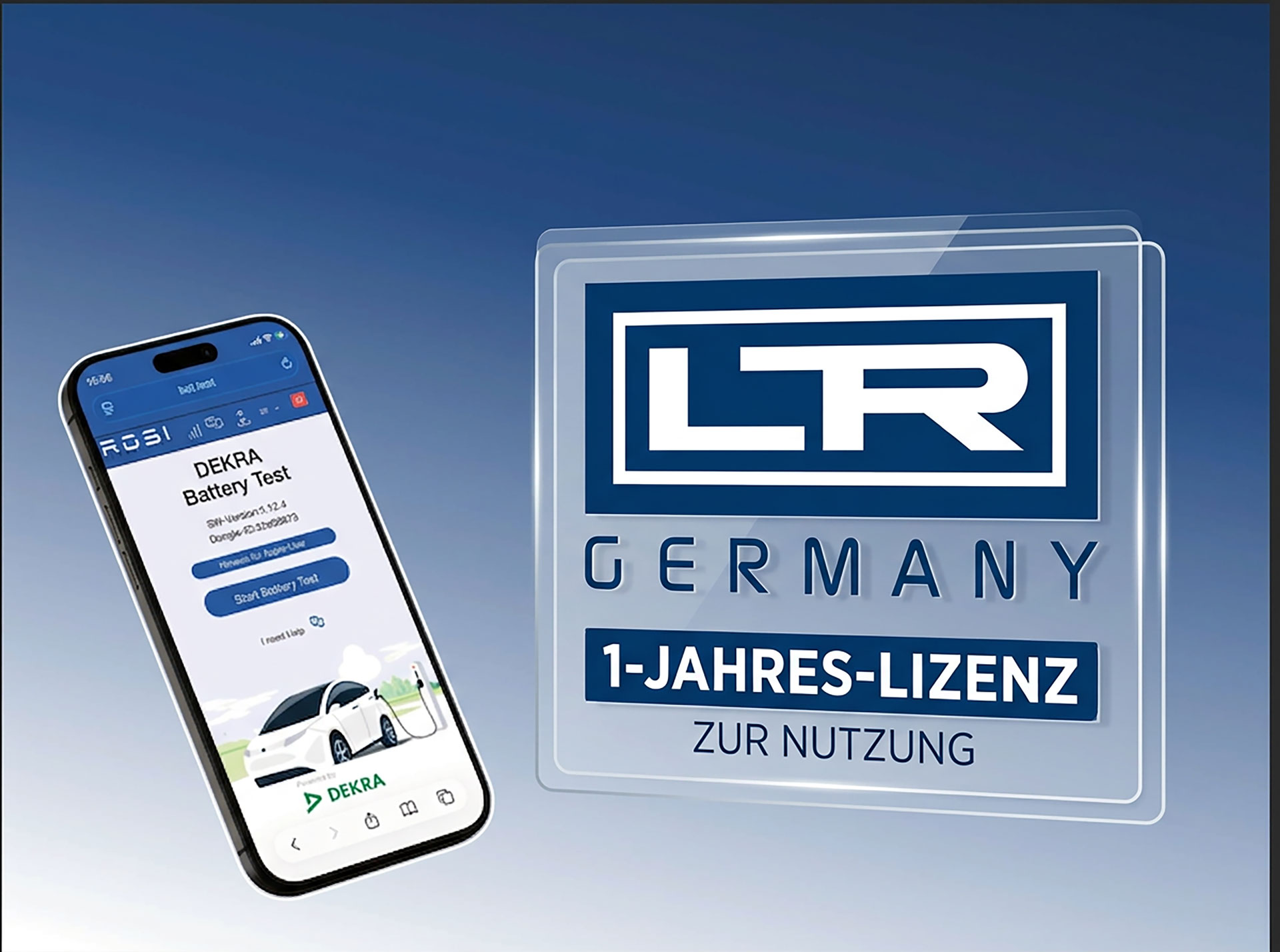
With the HVBD 01_LR Battery Testing System from Autotestgeräte Leitenberger, the State of Health (SoH) of supported high-voltage batteries can be determined and digitally documented. The system connects to the vehicle via the OBD2 interface and is operated using the BattCheck app.

Depending on the vehicle model, two different test procedures are available:

SoH Read-Out – Quick Test While Stationary

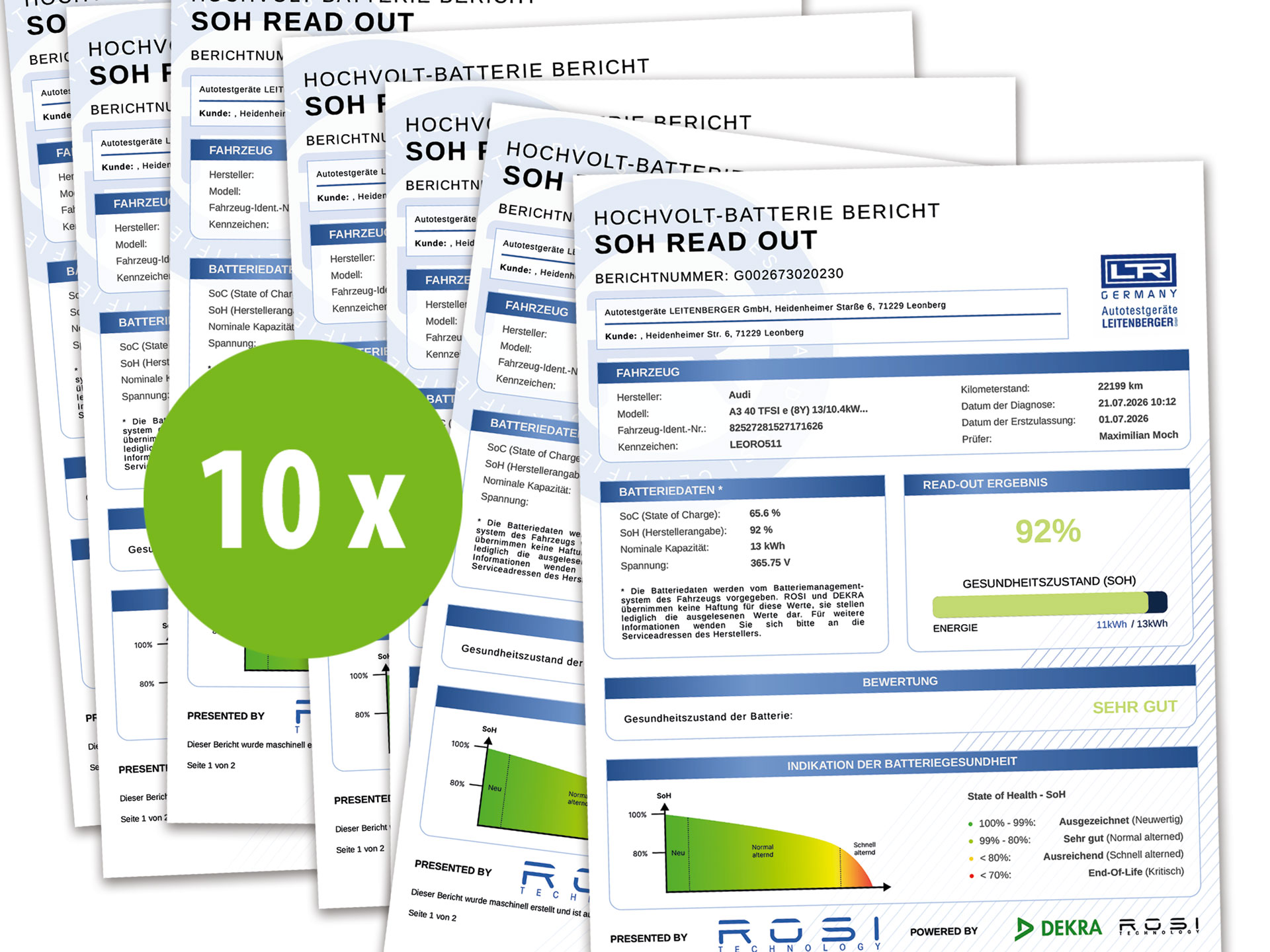
During the SoH Read-Out, relevant battery data is read directly from the Battery Management System (BMS). A test drive is not required. The result is a digital SoH report based on the battery data provided by the vehicle or the vehicle manufacturer.

Drive Test – dynamic battery test under load

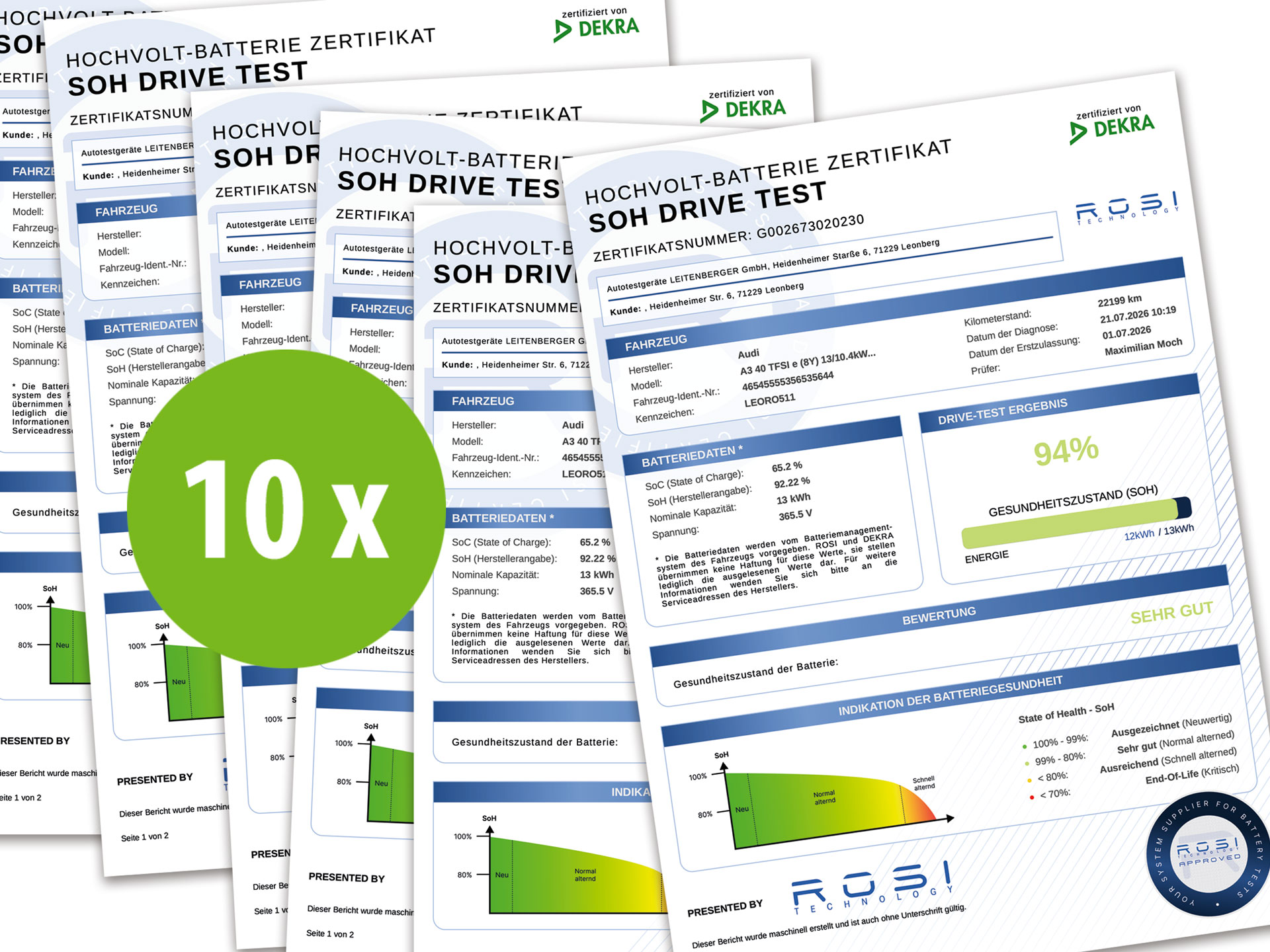
During the Drive Test, dynamic battery values are additionally recorded during a short acceleration drive. The evaluation is based on the patented DEKRA test procedure and enables a manufacturer-independent assessment of the battery’s condition. The result is provided as an SoH battery certificate.

The HVBD 01_LR is particularly suitable for auto repair shops, car dealerships, used car dealers, vehicle appraisal, lease returns, and fleet management. The documented battery condition can thus be used as additional information during vehicle purchase, trade-ins, sales, and customer consultations.

In addition to the diagnostic hardware, operation requires a valid connectivity and annual license as well as corresponding test quotas for SoH read-outs and drive tests. The availability of these two test procedures depends on the vehicle model. Therefore, current vehicle coverage should be checked before each test.

Mileage can be read. Battery condition should be measured.

Frequently Asked Questions About HV Battery Diagnostics and State-of-Health Testing

The condition of a high-voltage battery cannot be assessed based solely on age, mileage, or the displayed range. Professional SoH testing methods analyze battery data and enable transparent documentation of the battery's condition. The following questions explain State of Health (SoH), SoH readout, drive test, battery certificate, and the use of the HVBD 01_LR.

  • What does “State of Health” (SoH) mean for a high-voltage battery?

    State of Health, or SoH for short, describes the health or state of aging of a battery relative to a defined reference or new condition.

    The value is typically expressed as a percentage.

    How the SoH is specifically determined depends on the vehicle, the available battery data, and the testing method used.

  • What is the difference between SoH and SoC?

    SoC – State of Charge describes the battery’s current charge level.

    SoH – State of Health, on the other hand, describes the battery’s long-term condition or level of aging.

    To put it simply:

    SoC: How full is the battery?

    SoH: What is the battery’s condition?

  • Why is the “State of Health” important for a used electric car?

    High-voltage batteries degrade depending on various factors.

    These may include, for example:

    • Age
    • Charge and discharge cycles
    • Temperature
    • Usage
    • Proportion of fast charging
    • Operating conditions

    Therefore, two vehicles of comparable age and mileage do not necessarily have identical battery conditions.

    A documented SoH provides additional transparency regarding the condition of the traction battery.

  • Can you tell the condition of an electric car's battery by its mileage?

    No.

    'Mileage is just one of several factors that can affect battery aging.

    Calendar age, temperature, charging habits, and operating conditions can also affect the battery’s condition.

    For a more accurate assessment, the battery’s condition should therefore be checked directly.

  • What is the HVBD 01_LR?

    The HVBD 01_LR is a professional battery testing system from Autotestgeräte Leitenberger designed to determine and document the state of health (SoH) of high-voltage batteries.

    The system connects to the vehicle via the OBD2 interface and is operated using the BattCheck app.

    Depending on the vehicle, either an SoH readout, a drive test, or both test methods are available.

  • For which vehicles is the HVBD 01_LR suitable?

    The HVBD 01_LR is intended for supported battery electric vehicles (BEVs) and plug-in hybrid vehicles (PHEVs).

    Not every vehicle supports both test procedures.

    Depending on the vehicle model, the following may be possible:

    • only an SoH readout,
    • only a drive test, or
    • the execution of both test procedures

    Therefore, the current vehicle coverage should always be checked before performing a battery test.

  • Can any electric car battery be tested with the HVBD 01_LR?

    No.

    The test procedures depend on the specific vehicle support.

    Model coverage is continuously being expanded. Therefore, before performing a test, you must verify whether the specific vehicle model and the desired test procedure are currently supported.

  • What is a SoH readout?

    With the SoH Read-Out, relevant battery data is retrieved directly from the vehicle's battery management system via the OBD interface.

    The vehicle does not need to be driven for this process.

    The results are provided within a few minutes as a digital SoH report.

  • What is a Battery Management System (BMS)?

    The Battery Management System, or BMS for short, monitors and controls key functions of the high-voltage battery.

    Depending on the vehicle, it processes or monitors, for example, battery status, voltages, temperatures, state of charge, and other relevant battery data.

    During the SoH readout, the HVBD 01_LR uses the information provided by the respective vehicle or BMS.

  • Is the SoH readout vendor-independent?

    No.

    The battery status reported by the SoH readout is based on the data or assessments provided by the respective vehicle and its BMS.

    The value therefore depends on the vehicle manufacturer or its BMS strategy.

  • What is the Drive Test?

    The Drive Test is a dynamic battery test.

    First, static battery data is collected. Then, during a short drive, additional battery values are recorded under real-world conditions.

    This measurement data is then analyzed to assess the condition of the high-voltage battery.

  • Why is the battery put under load during the drive test?

    A battery behaves differently under load than when it is completely at rest.

    During the drive test, additional measurements are therefore taken during a defined acceleration.

    This allows the battery’s behavior under real-world operating conditions to be factored into the evaluation.

  • How does the drive test with the HVBD 01_LR work?

    The typical procedure is as follows:

    1. Connect the HVBD 01_LR to the vehicle via OBD2.
    2. Launch the BattCheck app and select the vehicle.
    3. Record static battery data.
    4. Perform a short acceleration test.
    5. Record dynamic battery values.
    6. Analyze the data digitally.
    7. Receive the SoH battery certificate.

    Depending on the vehicle and test procedure, only a short, suitable stretch of road is needed for the acceleration test.

  • What is the difference between a SoH readout and a drive test?

    The most important difference lies in the testing procedure.

    SoH Read-Out:

    • Stationary testing
    • No test drive
    • Vehicle BMS data
    • Manufacturer-specific SoH assessment
    • Digital SoH report

    Drive Test:

    • Static and dynamic measurement data
    • Short test drive
    • Measurement under load
    • Patented DEKRA testing procedure
    • Manufacturer-independent assessment
    • SoH battery certificate
  • Which test method is better—SoH read-out or drive test?

    There is no one-size-fits-all answer to that.

    The SoH Read-Out provides a quick way to read the battery status provided by the vehicle or the BMS.

    The Drive Test supplements the static data with a dynamic measurement under load and enables a manufacturer-independent evaluation based on the DEKRA test procedure.

    Which procedure is appropriate depends on the desired level of testing and vehicle coverage.

  • How long does a SoH readout take?

    The SoH readout is performed entirely while the vehicle is stationary and provides a digital battery report within a few minutes.

    A test drive is not required.

  • How long is the test drive during the Drive Test?

    During the HVBD 01_LR test, a short acceleration run is performed to record dynamic battery values.

    The actual acceleration phase typically requires a distance of only about 100 meters.

    The exact requirements are specified by the BattCheck app or the respective test procedure.

  • Does the high-voltage battery need to be removed for testing?

    No.

    The HVBD 01_LR connects via the vehicle's OBD2 interface.

    The high-voltage battery does not need to be opened or removed for SoH readout or drive testing.

  • Does the high-voltage system need to be opened for the battery test?

    No.

    The battery data is collected via the vehicle interface.

    Performing the SoH readout or drive test does not involve direct intervention in the open high-voltage battery system.

  • What is the purpose of the BattCheck app?

    The BattCheck app guides the user through the battery test.

    After connecting the HVBD 01_LR to the OBD2 interface, the vehicle is selected in the app.

    Depending on the test procedure, the app assists with:

    • Vehicle selection
    • Entering required vehicle data
    • Reading battery data
    • Performing the SoH readout
    • Performing the drive test
    • Transferring measurement data
    • Providing the results
  • Where can I find the battery test results?

    The test results are provided digitally.

    Depending on the testing method, the user receives either a digital SoH report or an SoH battery certificate.

    The results can be provided via email or through the BattCheck app.

  • What is the difference between a SoH report and a battery certificate?

    During the SoH Read-Out, a digital SoH report is generated.

    This report documents the assessment of the battery state provided by the vehicle or the BMS.

    During the Drive Test, an SoH battery certificate is generated based on static and dynamic measurement data and the patented DEKRA testing procedure.

  • What is a battery certificate for an electric car?

    A battery certificate documents the determined condition of a high-voltage battery at the time of the inspection.

    It can be used, for example, in the following situations:

    • Vehicle purchase
    • Used car sale
    • Lease return
    • Vehicle appraisal
    • or for condition documentation

    as additional information.

  • Why can a battery certificate be useful when selling a used car?

    The condition of a high-voltage battery is not immediately apparent from the outside.

    A documented battery condition therefore provides additional transparency for both sellers and buyers.

    The certificate can supplement a traditional vehicle appraisal with information on the condition of the traction battery.

    However, a specific increase in value or a specific selling price cannot be generalized based on this information.

  • Is a SoH battery certificate the same as the EU Battery Passport?

    No.

    An SoH battery certificate documents the results of a specific condition assessment.

    The EU Battery Passport, on the other hand, is a legally defined digital record containing comprehensive information about a battery.

    An SoH test or SoH battery certificate does not replace the EU Battery Passport.

  • Can the HVBD 01_LR be used to determine the remaining range of an electric car?

    The focus of HVBD 01_LR is on assessing the health of the high-voltage battery.

    The actual achievable vehicle range also depends on numerous other factors, such as:

    • Outside temperature
    • Driving speed
    • Driving style
    • Heating and air conditioning
    • Vehicle load
    • Tires
    • Route profile

    The SoH should therefore not simply be equated with a guaranteed remaining range.

  • Does a SoH of 90% mean that the vehicle has exactly 90% of its original range?

    No.

    Although the SoH and the actual range are related, they are not the same.

    Range is also influenced by the vehicle, temperature, driving profile, auxiliary consumers, and other factors.

    The SoH should therefore be understood as an indicator of the battery's condition and not as a direct measure of range.

  • Can the HVBD 01_LR locate individual defective battery cells?

    The HVBD 01_LR is primarily intended for the professional assessment and documentation of the battery’s overall condition, or State of Health.

    A detailed repair diagnosis at the cell or module level is a separate diagnostic task.

    Which individual parameters are available during a test depends on the vehicle and the test procedure. Therefore, one should not make a blanket statement that the device can locate individual defective cells.

  • Can the HVBD 01_LR predict the remaining service life of the high-voltage battery?

    No.

    The test evaluates the battery's condition at the time of testing.

    Future aging depends on numerous factors, such as usage, temperature, charging behavior, and operating conditions.

    Therefore, a definitive remaining service life cannot be determined from a current SoH.

  • Can a good SoH guarantee that the battery has no defects?

    No.

    The State of Health is an important performance indicator, but it does not replace a comprehensive technical fault diagnosis of all battery components.

    In the event of specific error messages or technical anomalies, additional diagnostic and testing procedures may be required.

  • Does the SoH test replace an electrical safety inspection of the high-voltage battery?

    No.

    Assessing the battery's condition and performing an electrical safety inspection are two different tasks.

    Depending on the repair or the vehicle's condition, additional measurements—such as insulation tests or other safety checks—may be required.

    You can find suitable equipment under HV Safety and Electrical Tests on Electric Vehicles.

  • Does the SoH provide any information about the battery case's watertightness?

    No.

    The SoH assesses the condition or aging of the high-voltage battery.

    The leak-tightness of the battery housing is a separate technical characteristic.

    After certain repairs, a leak test of high-voltage batteries and high-voltage components may therefore be required, regardless of the SoH.

  • For which businesses is a professional SoH audit a good idea?

    The HVBD 01_LR is particularly well-suited for:

    • Auto repair shops
    • Car dealerships
    • Used car dealers
    • Vehicle appraisal
    • Vehicle purchase and trade-ins
    • Lease returns
    • Vehicle fleets

    This allows battery testing to be integrated into existing vehicle appraisal and repair shop processes as an additional service.

  • Why is the SoH inspection important for leased vehicles returned at the end of the lease?

    When a leased vehicle is returned, the condition of the entire vehicle is documented and evaluated.

    However, the condition of the high-voltage battery can only be assessed to a limited extent from the outside.

    An additional SoH test can therefore provide additional information about the traction battery to supplement the existing vehicle condition assessment.

  • Can the HVBD 01_LR be used when trading in an electric car?

    Yes.

    Vehicle purchases and trade-ins are among the intended applications.

    The documented battery condition can provide the dealership with additional information for the technical evaluation of the vehicle.

  • Is a license required to use HVBD 01_LR?

    Yes.

    In addition to the hardware, a valid connectivity and usage license is required to perform the battery tests.

    The corresponding annual license is valid for 12 months.

  • Is a test quota required for every battery test?

    Appropriate test quotas are required for SoH readouts and drive tests.

    These quotas can be purchased separately or reordered as needed.

    This allows the number of battery tests that can be performed to be adjusted to the actual operational needs.

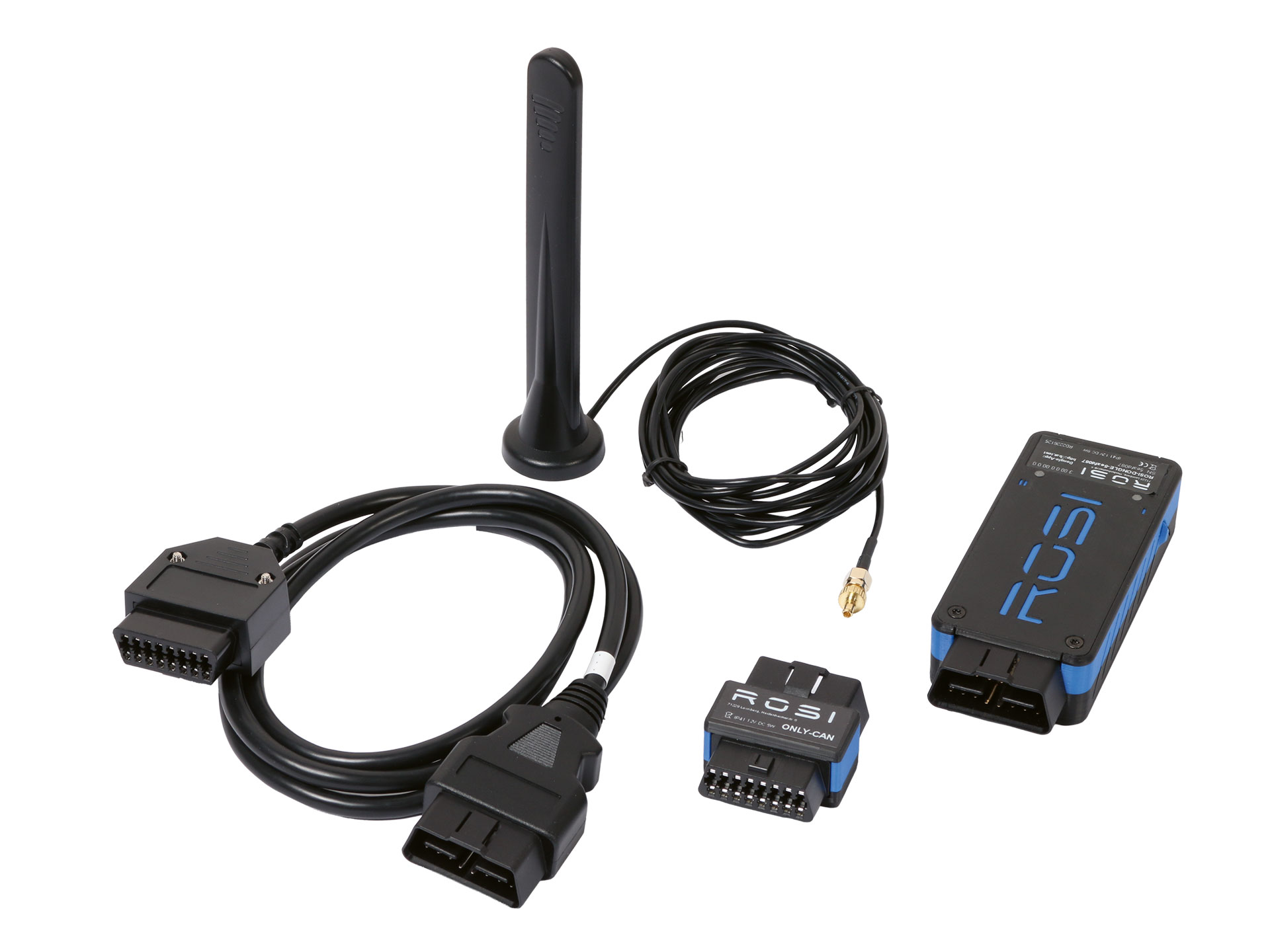
  • What's included in the HVBD 01_LR Starter Pack?

    The Starter Pack combines the components you need to get started right away with professional HV battery testing.

    It includes:

    • HVBD 01_LR hardware case
    • Dongle
    • OBD cable
    • ONLY-CAN adapter
    • Antenna
    • Carrying case
    • 12-month connectivity and usage license
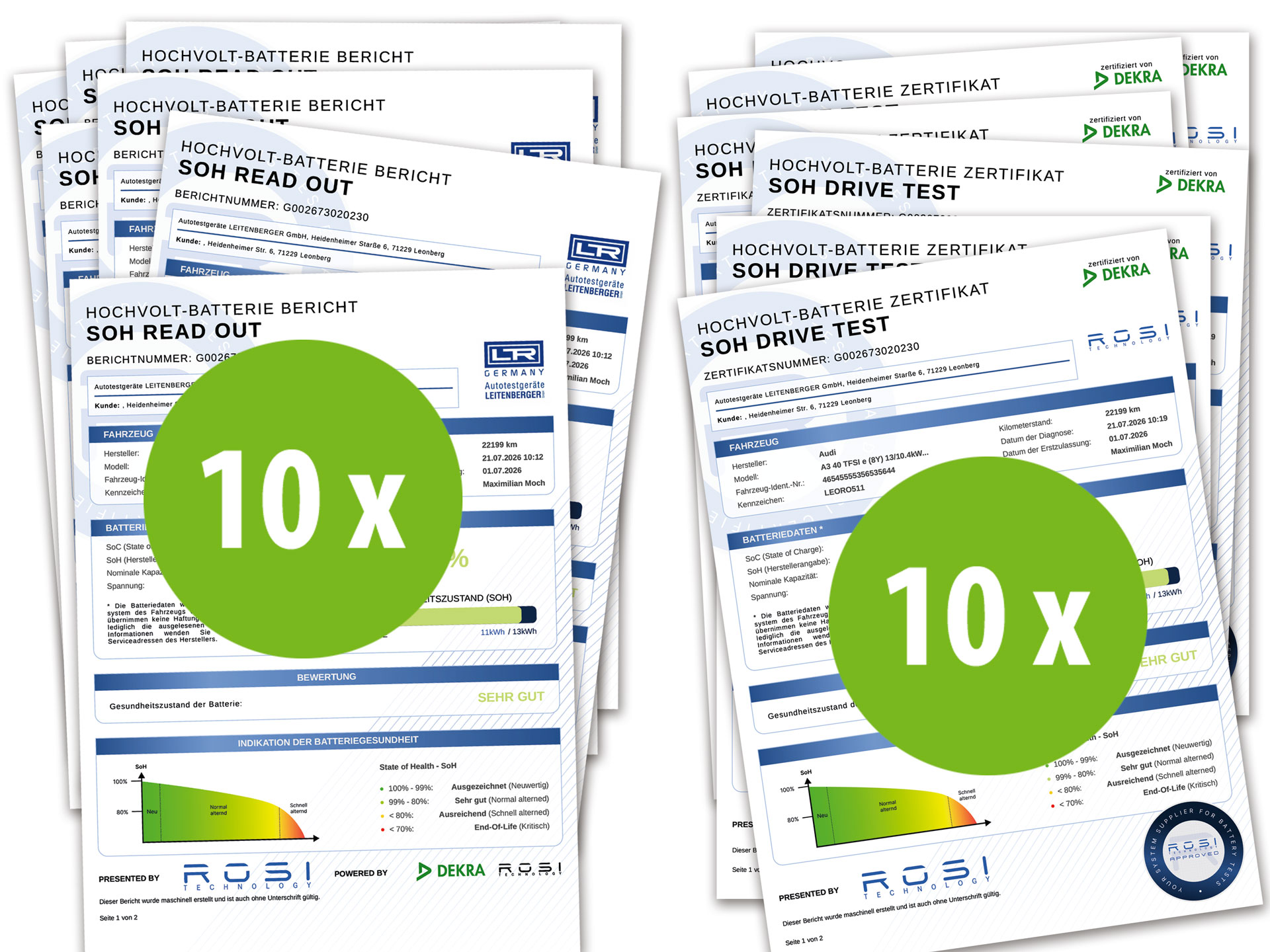
    • 10 SoH readouts
    • 10 drive tests

    This provides a total of 20 battery tests to start with.

  • Can additional SoH readouts and drive tests be requested?

    Yes.

    Test quotas can be reordered separately as needed.

    This means that when test quotas are used up, you don't have to purchase the entire hardware setup again.

  • Why should the vehicle cover be checked before every test?

    The available data and technical interfaces vary by vehicle manufacturer and model.

    Therefore, not every vehicle supports both test methods.

    The current vehicle coverage shows whether, for the vehicle in question:

    • an SoH readout,
    • a drive test,
    • or both methods

    can be performed.

  • Is the Drive Test available for all vehicles?

    No.

    The availability of the Drive Test depends on the specific vehicle model.

    The same applies to the SoH readout.

    Therefore, you should always check the current vehicle coverage before running the test.

  • How can the SoH test be integrated into a repair shop’s e-mobility services?

    The battery inspection can be offered, for example, as an additional service for:

    • Used car inspections
    • Vehicle purchases
    • Trade-ins
    • Lease returns
    • Inspections
    • Sales appraisals
    • Fleet inspections

    It thus complements other testing and diagnostic solutions for e-mobility and alternative powertrains by providing a condition assessment of the high-voltage battery.

Cookie settings
This website uses cookies that enable you to use services offered by external providers, such as YouTube or Google Maps. The legal basis here is Art. 6 DSGVO (1) a.

Here you can object to the anonymized recording of your user behavior by MATOMO. For this purpose, we store a cookie on your computer to respect this decision also on subsequent visits.

Please note that depending on your settings, some functions may not be available.

You can find more information in our Privacy policy

Matomo settings

Attention: When you object to tracking, a Matomo deactivation cookie is set that remembers your objection.